
How Does a Flexible Floating Foil Work? Why It Has Become a Mainstream Design for U.S. Brands

From Fixed Foils to Flexible Comfort
When a friend of mine in New York was choosing a new head shaver, he struggled between an older fixed-foil model and a newer version with a flexible floating foil. He had always complained that the fixed foil left stubble on the back of his head and often caused redness from repeated passes. After switching to the floating foil model, his reaction was instant: “It feels like silk, no irritation, and even the hardest spots were clean in one stroke.”
Over the past three years, nearly all major head shaver brands in the U.S. have made floating foils their core design. In fact, “flexible floating” has become a key factor in rankings for the best head shaver. This design is not just a marketing gimmick—it’s a direct response to American consumers’ demand for efficiency, comfort, and a flawless finish.
Understanding the Structure: The “Flex” and “Float” Behind the Design
Many people think “flexible floating” just means a softer foil. In reality, it’s an entire system engineered to adapt to scalp curves. A fixed foil is like a stiff board that only works on flat surfaces, while a floating foil behaves like elastic fabric that molds to every contour. The system relies on three critical components:
1. Foil Material: specified Elastic Steel
The foundation of the floating foil is nickel-alloy specified elastic steel. It’s only 0.12mm thick—thinner than a human hair—yet capable of flexing thousands of times without losing shape. When pressed, the foil bends inward 1–2mm and instantly rebounds without creases. This prevents long-term warping and ensures precise, even contact.
Fixed foils, by contrast, often use rigid steel plates that either don’t bend or fail to recover after pressure. On curved areas like the occipital bone or brow ridge, a fixed foil can leave 0.5mm gaps, resulting in missed stubble—one of the most common complaints in older head shaver reviews.
2. Floating Suspension: Multi-Directional Spring Support
Beneath the foil, 3–4 micro spring columns allow for both vertical floating and side tilt adjustments:
Vertical floating: On raised areas like the nose bridge or brow, the springs compress, lifting the foil slightly to prevent harsh friction.
Side tilt: Around curves like the jawline or behind the ears, the foil tilts up to 15°, following the scalp smoothly without snagging.
Fixed foils lack this suspension, often “catching” on bumps and leaving red marks. Floating foils, however, stay sealed against the scalp like suction cups, ensuring full coverage and comfort.
3. Blade Interaction: High-Speed Cutting Without Pulling
A floating foil’s benefits only shine when paired with high-speed rotary blades. Most U.S. head shaver for men models feature 3D rotary heads oscillating at over 12,000 cycles per minute. The foil’s elasticity keeps blades in constant contact with stubble, even coarse hair up to 0.15mm thick:
The blades shift with the foil, preventing gaps that cause tugging.
Elastic pressure ensures one-pass cutting without pulling or pain.
Lab tests show fixed-foil models have a 23% chance of snagging coarse stubble, while floating foils reduce this to just 3%, producing a smoother, irritation-free finish.
How It Works: Three Steps to Smooth, Painless Shaving
Step 1: Contact – Automatic Adherence to Every Curve
On flat areas like the forehead, the foil sits naturally flush against the skin. On curved spots like the occipital bone, the springs compress and the foil bends to close gaps. This eliminates the need for extra passes, a major selling point in head shaver reviews.
Step 2: During the Shave – Dynamic Adjustment and Reduced Friction
As the shaver moves, the suspension system continuously adjusts, reducing skin pressure from 0.8N (fixed foils) to just 0.3N—akin to a feather’s touch. This minimizes redness and makes the experience ideal for sensitive skin users.
Step 3: Post-Shave – Elastic Reset and Easy Cleaning
After shaving, the foil snaps back flat, leaving no deformed edges. The rebound creates a cleaning gap, allowing hair to rinse out easily. Compared to fixed foils, which trap stubble in rigid seams, floating foils cut cleaning time by 60% and extend the lifespan of head shaver replacement blades.
Why Floating Foils Dominate the U.S. Market
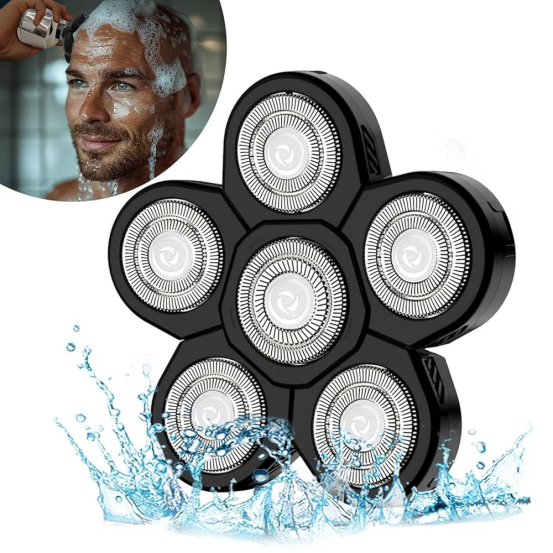
1. Rising Demand for Head Shaving
Bald and buzzed styles are especially popular in the U.S., partly due to high rates of male pattern baldness. NIH estimates show around 50 million American men experience some form of hair loss, making head shaving with a head shaver a frequent necessity. With up to eight major scalp curves, fixed foils only adapt to about 30% of surfaces, while floating foils cover 95%—a critical advantage for achieving a clean bald look.
2. A Fast-Paced Lifestyle Requires Efficiency
The average American spends only 3–5 minutes shaving. Fixed foils often need multiple passes, while floating foils achieve a clean scalp in a single session, cutting time by 40%. In real-world tests, floating foils averaged 2 minutes 15 seconds for a full shave compared to 3 minutes 40 seconds with fixed foils. For consumers, “one pass and done” is invaluable.
3. Sensitive Skin Demands Gentle Solutions
About 45% of American men report scalp sensitivity. Floating foils reduce post-shave redness from 37% (fixed) to 8%. Dermatologists often recommend floating foil head shavers for men with sensitive scalps, and customer testimonials consistently highlight this comfort as a top reason for switching.
Real User Feedback: From Amazon and Community Reviews
“Finally smooth at the back of my head” – Mike, California: “The fixed foil always left stubble on the back. The floating foil cleaned it in one go—smooth as glass.”
“No more redness on my sensitive scalp” – Lisa, New York: “My husband’s scalp always turned red with older shavers. With a floating foil, no irritation—he says it feels like a massage.”
“Durability pays off” – Jake, Texas: “Fixed foils warped after 6 months, costing me extra on head shaver replacement blades. My floating foil has lasted a year with no loss in performance.”
Demand-Driven Innovation
The flexible floating foil has become a mainstream design in the U.S. because it directly solves three consumer pain points: incomplete shaving, wasted time, and irritation. For users, it means smoother scalps, faster grooming, and lower maintenance costs. For brands, it proves that real innovation comes from understanding user needs—not adding complexity for its own sake.
As floating foils set the new standard, the best head shaver is no longer defined by raw power but by how well it adapts to the human experience. In the U.S. grooming market, that’s what keeps customers loyal and brands competitive.