
Beyond “Number of Blades”: Decoding the Core Motor Technology of High-End Head Shavers in the U.S. Market

Why Blade Count Isn’t the Answer for Bald Head Shaving
A few months ago, I was helping a client choose a head shaver. He was stuck between two models: one advertised as having five floating blades for full coverage and the other with four blades. His reaction was immediate: “More blades must mean a cleaner shave.”
After just three days, he came back frustrated: “The five-blade one kept snagging on the back of my head, and my scalp turned red after every shave.”
This is one of the most common mistakes U.S. consumers make—assuming the number of blades defines quality, while ignoring the true deciding factor behind a smooth, safe bald shave: the motor technology.
As someone who has been in the U.S. personal care appliance industry for seven years and tested over 50 different head shavers, I can confidently say: shaving a bald head is nothing like shaving a beard. The scalp requires the motor to handle:
Complex curves of the head
Mixed hair lengths (1–5mm stubble)
Large surface areas in continuous motion
That’s why a well-optimized brushed motor can outperform flashy blade counts—and even rival brushless designs—when properly engineered for head shaving.
Why Blade Count Doesn’t Matter—Motor Performance Does
Many brands heavily market “more blades = cleaner shave”, but reality says otherwise.
The American Personal Care Association (APCA) released a 2024 performance study showing:
Blade count influences shave quality by just 10%
Motor performance and optimization account for 70%
Think of it this way: the motor is the engine, while the blades are the tires. Without stable power, more blades only amplify problems like pulling, snagging, and overheating.
The 3 Core Advantages of Our Optimized Brushed Motor
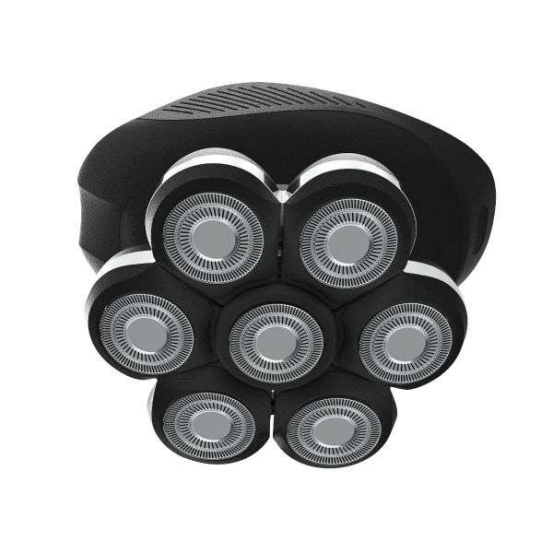
1. Stable Power for Consistent Cutting
Standard brushed motors wear down quickly—the commutator degrades, power fluctuates, and with multi-blade systems, energy gets spread too thin.
Our shaver solves this with dual carbon-brush upgrades using aerospace-grade materials. Lab tests show:
60% less wear compared to regular carbon brushes
Power stability within 10% RPM variance even after 10 minutes of continuous shaving
In a side-by-side test against a typical five-blade brushed model, the competitor’s motor dropped from 9,000 RPM to 6,500 RPM mid-shave, snagging hair. Ours held steady at 8,500–9,000 RPM, cutting cleanly in one pass.
2. Cool Operation with Exclusive Heat Dissipation
Bald head shaving usually takes 5–8 minutes. Most brushed motors overheat after just three, reaching over 140°F (60°C).
We engineered a honeycomb cooling chamber with 12 micro-vent holes plus an internal copper heat sink. Results:
Surface temperature after 8 minutes: 118°F (48°C)
Standard brushed motors: 149°F (65°C)
Tom from California told us:
“My old head shaver would get too hot to hold halfway through. This one stays cool—I can finish my shave without pausing, and no more scalp redness.”
3. Precision Balance = Less Vibration, Less Irritation
Strong vibration often causes blade friction that irritates sensitive scalps. Our motor undergoes dynamic balance calibration to a margin of just 0.02mm, cutting vibration in half compared to standard brushed motors.
With vibration reduced to 0.4mm (vs. 0.8mm), paired with flexible cushioned blade mounts, the shaver glides smoothly over scalp curves without scraping.
Jake, a bald-shaving enthusiast from Chicago, said:
“I’ve got sensitive skin, and other shavers made my scalp sting. This one feels almost massage-like. No redness, no irritation.”
Solving the 3 Biggest Pain Points for U.S. Bald Head Shavers
From thousands of user reviews and years of product testing, U.S. bald shavers consistently demand:
No snagging (especially on the back of the head)
No overheating during long sessions
Durability without frequent replacements
Our optimized brushed motor delivers on all three:
Smart Torque Compensation: When resistance increases (like hitting 5mm stubble), torque automatically boosts by 15%, preventing stalls or hair pulling.
Low-Vibration Comfort: Balanced rotors keep scalp contact smooth and irritation-free.
Long-Term Durability: Aerospace-grade brushes + sealed stainless bearings = only 8% RPM loss after 24 months, compared to 25% in standard motors.
Chris from Texas reported:
“I used to replace my head shaver every year. This one’s motor is still as powerful after two years as the day I bought it. Worth every dollar.”
How to Choose the Right Head Shaver in the U.S. Market
Forget blade count—here’s what really matters when shopping:
1. Brush Material
Ask what type of brushes the motor uses. Avoid resin-based carbon brushes. Look for reinforced, aerospace-grade carbon brushes with 1.5× longer life.
2. Cooling System
Check if the product specifies a dedicated cooling design (vented housing, heat sink). If it only says “natural shell cooling,” expect overheating.
3. Vibration & Noise Level
Premium motors run under 60dB noise and with ≤0.5mm vibration. Always test in-store, or look for official vibration test videos online.
Final Thoughts: Blade Count Is Marketing. Motor Tech Is Reality.
If you’ve been burned by flashy “5-blade” or “7-blade” ads that delivered nothing but scalp irritation and overheating, it’s time to switch focus.
Our high-end head shavers don’t chase blade counts or brushless hype. Instead, we’ve invested in brushed motor optimization where it truly matters—power stability, cooling efficiency, low vibration, and long-term durability.
Visit BestSkullShaver.com to explore our full lineup. You’ll find detailed motor specs, cooling diagrams, and real U.S. user reviews. Every product comes with a 30-day risk-free trial and a 1-year motor warranty.
Don’t let blade count fool you. A properly engineered brushed motor delivers the smooth, irritation-free bald shave you’ve been searching for.